
Updated July 2026
I want to tell you a story from before I became a wedding officiant.
An administrator at my school got married. She was well-liked, professional, genuinely good at her job. And she invited the entire administrative team to her wedding.
We were a good team. Effective, respectful, the kind of group that worked well together and made the school function. But none of us had ever spent time together outside of school in a personal, social way. Not once. No dinners, no happy hours, nothing that crossed the line from colleagues into friends.
And quietly, in the way that people do when they are trying to be polite about something uncomfortable, we all said the same thing to each other: she invited us out of obligation and we are going out of the same. We liked her a lot and we were friends at work. But none of us knew her in that way. The kind of way that you participate in the most intimate and important moment of her life. It almost makes me feel bad describing it this way, but I know you understand what I mean.
The wedding was at 3pm. By the time dinner was served and the evening wound down it was well past 10 pm. We stayed because we felt we had to. We left as soon as it felt acceptable. Seven hours of our Saturday given out of obligation to someone who invited us out of obligation, and neither side of that equation served anyone well.
I think about that wedding a lot now that I stand at the front of ceremonies for a living. Because what I felt at that table is exactly what I sometimes sense from the altar. A section of guests who are present without being there. And it is one of the things I most want to help couples avoid.

Guy at Bella Collina waiting for the ceremony to begin
The Question That Cuts Through Everything
Imagine you handed in your resignation tomorrow. In six months, would you still be texting this person?
Not messaging them on Teams. Not liking their LinkedIn posts. Actually texting them, the way you text a friend.
For most workplace relationships the honest answer is no. And that is not a character flaw on anyone's part. Most workplace relationships are built on shared proximity rather than genuine personal connection. You see the same people every day, you develop a shorthand, you enjoy their company. But the relationship exists because of the context, not in spite of it. Remove the context and the relationship quietly fades.
That is a perfectly normal and healthy thing. It is also a clear signal about who belongs at your wedding.
The people who survive a job change, a move across the country, or a season of life where you simply stop seeing each other every day, those are your people. Everyone else is a colleague and a perfectly good one who deserves your genuine warmth and absolutely no obligation to invite.
Have They Ever Been to Your House?
Here is a simpler version of the same question.
Have they ever been to your home? Have you ever met their partner or their kids? Do they know anything about your life that you did not tell them at work?
If the answer to all three is no, you have a friendly professional relationship. That is valuable. It is just not the same as friendship and your wedding is not the place to blur that line.
Your wedding ceremony is a personal milestone. The people sitting in those chairs should be people who have seen your real life, not just your professional one. Someone who has only ever known you in the context of meetings and shared deadlines has not really seen you. They have seen the version of you that shows up to work. That is a different person.
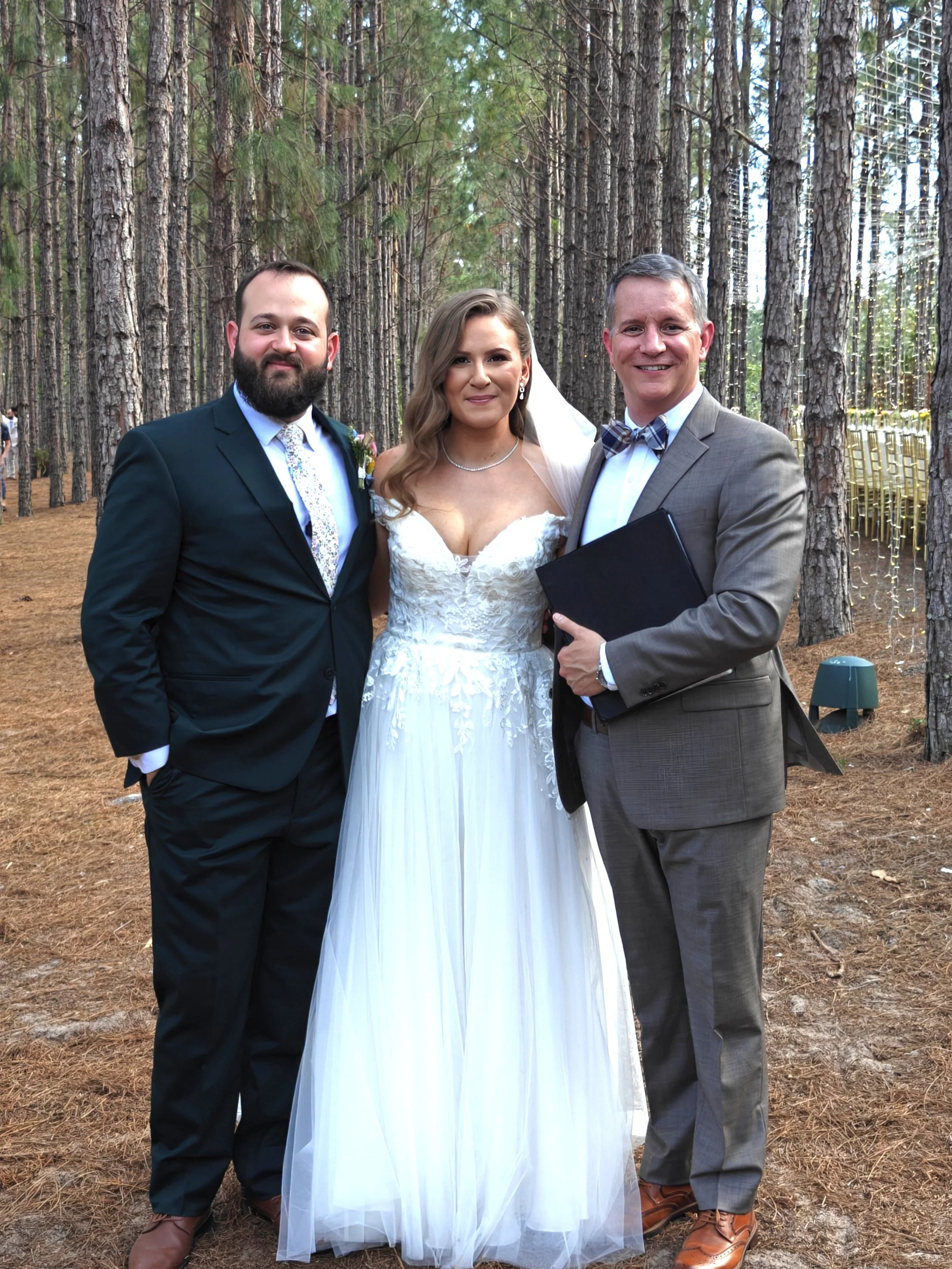
Guy celebrating with a couple after their ceremony at The Pinery
The Boss Problem
Inviting your direct supervisor creates a specific kind of tension that most couples do not fully think through until they are standing at the altar.
Your wedding day is the one day in your life when you are not performing for anyone. You are not managing impressions, you are not being professional, you are not carefully curating what you say and how you say it. You are just you, completely and without reservation, in front of everyone you love.
Having your boss in that room changes that. Subtly, probably unconsciously, but it changes it. There is a part of your brain that will register their presence and adjust accordingly. You deserve a ceremony where no part of your brain is doing that.
Unless your boss is a genuine friend, someone you would invite regardless of whether they were your supervisor, the answer is almost always no. And the same logic applies to inviting part of a team when you are close to just two or three people. You are allowed to have favorites in your personal life. You do not owe your entire department a seat at your wedding because you enjoy some of them more than others.
You Are Actually Giving Them a Gift
Here is something most wedding planning advice never says: not inviting a coworker is often the kindest thing you can do for them.
When you invite someone out of obligation they feel the obligation to attend. You have just assigned them a task for their Saturday. They now need to find a gift, find an outfit, arrange their weekend around your schedule, sit through a ceremony where they only know a handful of people, and make polite conversation at a reception for several hours. And they will do all of that because they feel they have to, not because they genuinely want to.
Not inviting them gives them their Saturday back. It gives them the gift money back. It removes the social obligation entirely. Most people who do not make the cut at a wedding are quietly relieved, even if they would never say so. They will congratulate you genuinely on Monday morning and mean every word of it.
The awkward obligation runs both directions. Removing it is a kindness.
What the Room Should Feel Like
I have officiated hundreds of ceremonies. I have stood at the front of rooms that were full of genuine love and rooms that were full of people going through the motions of attending a wedding for someone they sort of know.
The difference is palpable. You can feel it as the officiant. The couple can feel it. The guests who are genuinely there for the couple can feel it.
I felt it from the other side at that teacher's wedding. Sitting at a table with colleagues I genuinely respected, picking at a plate of food that was not worth the wait, quietly calculating how much longer we needed to stay before leaving felt acceptable. Nobody at that table was present in any real sense. We were performing attendance.
Your wedding deserves better than performed attendance. A smaller room full of people who are completely present for you is a profoundly different experience from a larger room where some portion of the guests are there because they felt they had to be.
Look at your guest list right now and ask yourself honestly: if I looked out at these people during my vows, would every single face feel right? The ones that give you pause are worth reconsidering.
Your wedding is not an extension of your professional life. The people in those seats should be the ones who champion your story, know your history, and are genuinely there because there is nowhere else they would rather be.
Everyone else can hear about it at the office on Monday. And honestly, they will be relieved.