
When Should You Move Your Wedding to the Rain Plan?
Decide at the time your planner or venue has already written into your contract, and then honor that decision even if the sky tries to talk you out of it. That predetermined call time exists for a reason, and the couples who trust it almost always end up with a calmer ceremony. Waiting until the last second to flip to the rain plan is the one habit I'll gently steer you away from.
I actually love a well-built rain plan. The good planners and venues here in Central Florida put an exact decision time right in the contract, often a few hours before the ceremony, and they hold the line that once the call is made, it stays made. That is smart. But lately I've watched that good system get undone at a few weddings, and I want to tell you what I saw so it doesn't happen to you.
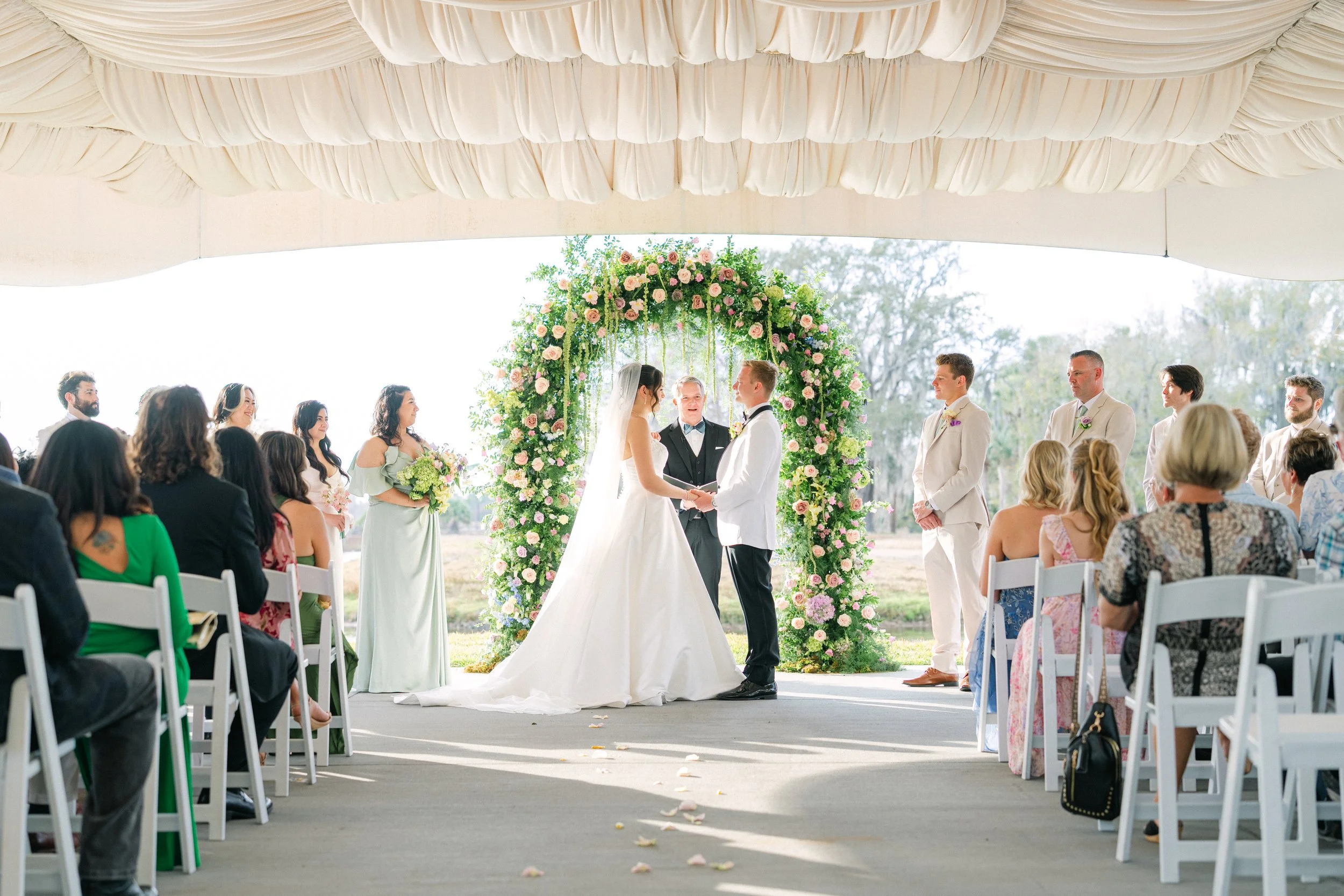
Proof that "Plan B" can be just as stunning as Plan A. When the weather turns, a well-built rain plan keeps the focus right where it belongs.
Here's the scene. I arrive on site, pull up my radar app, and I can tell with real certainty that we are getting rained out. There is lightning in the area. The ceremony space is still set up outdoors, untouched. I ask the planner, and she tells me the bride wants to wait until the last possible second. So I wait too, watching the radar turn an angrier shade of green. Finally I walk over to the bride myself and tell her honestly that I'm not comfortable standing at a mic under all that lightning. The call gets made two minutes before the ceremony was supposed to start, and then the entire staff flips the space, moving chairs, arch, and sound, while a hundred guests sit there and watch the scramble. That is a rough way to begin a wedding.
When should you decide to move to the rain plan?
At the exact time your contract specifies, full stop. If your planner says the rain call happens three hours out, let it happen three hours out. In Central Florida, summer storms roll through nearly every afternoon, often right around that late-day ceremony slot, and a radar map a few hours ahead is usually telling the truth. I understand the temptation to wait, since you planned for that garden or that lake and nobody wants to give it up over a sky that might clear. But a rain plan you keep renegotiating is not really a plan, it's a worry you carry all afternoon.
What happens if you wait until the last minute?
You hand your guests a front-row seat to the chaos instead of the ceremony. When the flip happens on schedule, before guests arrive, they walk into a finished, intentional space and never know there was a question. When it happens two minutes before start time, they watch staff haul chairs through a drizzle while everyone stands around awkwardly. The ceremony is the one moment when everyone is fully present, and the last thing you want is for that attention to land on a wet, rushed setup change.
There's a safety piece too. Lightning is not a wait-and-see situation. If there's lightning in the area, it isn't safe for anyone to be outside, including your guests, your photographer, and me holding a metal microphone under open sky. Once I see lightning, my honest recommendation is always going to be to move, and I'd rather give you that input early than at the altar.
Who should be part of the rain decision?
Your planner and venue lead it, you make the final call, and if we're on site, loop in your officiant and DJ too. We're the two vendors actually working out in that weather. I'm standing exposed at the front with a mic for the whole ceremony, and your DJ has speakers and electronics that do not love water. Both of us have worked plenty of Florida weddings and can give you a quick, grounded read on what we're seeing. You don't have to take our word as the deciding vote, but having us in the conversation gives you better information and one less thing to second-guess.
The whole point of a rain plan is to let you stop thinking about the weather and start enjoying your wedding. Decide early, trust the people you hired to make that call, and stick with it. A ceremony that starts in a calm, finished space, indoors or out, feels intentional from the first word. That's the experience I want every couple to have, and it's the whole reason Guy Thee Wed exists. If you want a ceremony that sounds like the two of you, rain or shine, I'd love to hear your story over at guytheewed.com.
A Few Common Questions
Can we change the rain plan after the call has been made? Most planners and venues build their contracts so that once the rain decision is made at the agreed time, it stays made, and I think that's the right approach. Reversing the call sends staff scrambling twice and rattles everyone's timeline. Trust the decision and let the day move forward.
What if it looks like the storm might pass in time? Sometimes it does, and that's frustrating when you've already moved indoors. But a rain plan is about removing risk, not gambling on a radar gap, and Central Florida storms are hard to time to the minute. A ceremony that starts on schedule in a dry space beats one that starts late while everyone watches the sky.
Does lightning really mean we have to move inside? Yes. Any lightning in the area means it isn't safe to hold a ceremony outdoors, regardless of whether it's actively raining where you're standing. Your officiant, guests, and vendors are all exposed out there, so lightning is a clear signal to move to your covered space